Then I paid for the thing and was done in five minutes.
I do this constantly. We all do. The free option is right there, practically begging to be chosen, and our brains can’t resist the gravity of zero dollars. It feels irresponsible to pay for something when a free version exists.
But free has a price. It always does. And the math almost never works out the way you think it will.
The Hidden Invoice
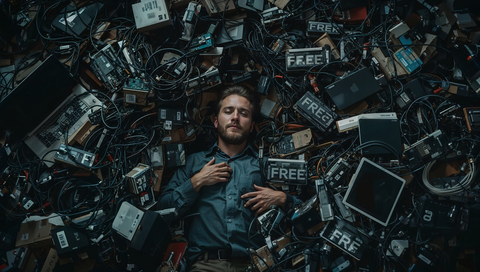
Every free tool sends you a bill. It just doesn’t arrive in your inbox.
- It arrives as the three hours you spent configuring something that should have taken ten minutes.
- It arrives as the Sunday afternoon you lost debugging an issue that the paid version handles automatically.
- It arrives as the slow realization, six months in, that the maintainer hasn’t pushed a commit since last summer and your entire workflow depends on their abandoned side project.
There’s a reason this keeps happening. Zero doesn’t behave like other prices. When researchers at MIT offered people a choice between a Lindt truffle for 15 cents and a Hershey’s Kiss for 1 cent, about 73% chose the truffle. Rational behavior.
Then they dropped both prices by one cent, making the truffle 14 cents and the Kiss free. Suddenly the majority flipped to the Kiss, even though the price gap between the two options was identical.
Our brains treat zero as a categorically different thing. A zero price tag doesn’t just remove cost. It seems to add perceived benefit. We don’t see free stuff as cheap. We experience it as genuinely better than it is.
Amazon learned this the hard way when they launched free shipping globally. Every country saw a massive jump in sales except France, where the offer had been set to one franc (about twenty cents) instead of zero.
From a rational perspective, those two offers are almost indistinguishable. In practice, the one-franc offer produced zero sales increase. When France switched to truly free, sales jumped immediately.
This is the gravitational pull that every paid product is competing against.
And it means that the actual cost of a free tool (your time, your frustration, the risk of abandonment) is almost invisible at the moment you choose it, because your brain has already categorized “free” as a win.
What Free Actually Costs
The hidden costs of free tools tend to follow a predictable pattern. Here’s what I’ve seen play out repeatedly, both in my own projects and across the industry:
| What You Expect | What Actually Happens |
|---|---|
| Quick setup, no cost | Hours of configuration, undocumented edge cases |
| Community support | Stale GitHub issues, unanswered questions |
| Ongoing maintenance | Maintainer burnout, project abandoned |
| Full control over your stack | You become the support team, forever |
| Freedom from vendor lock-in | Locked into an unmaintained dependency instead |
The open source maintainer burnout problem makes this concrete. Sixty percent of open source maintainers are not paid for their work. That number hasn’t moved in years. The same percentage have quit or considered quitting their projects, and 44% cited burnout as their reason for walking away.
The software we depend on every day is often maintained by a handful of unpaid volunteers who eventually run out of energy. The software is free, but sustainability requires resources that “free” doesn’t generate.
In late 2025, Kubernetes announced that Ingress NGINX would receive no security patches after March 2026, because the maintainers working nights and weekends couldn’t keep going.
This wasn’t some niche library. It was infrastructure that thousands of organizations depended on, with a known expiration date stamped on it. The maintainers didn’t get bored. They got burned out, because nobody was paying them to do the work that everyone relied on.
When you build your workflow around a free tool, you’re making a bet. You’re betting that whoever maintains it will keep maintaining it indefinitely, for free, despite increasing demands on their time and attention.
That bet pays off often enough that we keep making it. But when it doesn’t, you own the problem.
Curation Is the Product
Open any category of software tool and you’ll find dozens of free alternatives. Email marketing, project management, image editing, analytics. The free options exist, and many of them are genuinely decent.
So why does anyone pay?
Because finding the decent one is the expensive part.
There is more free stuff available than ever before, and the quality distribution is brutal. For every solid free option, there are fifteen mediocre ones and five that will actively waste your time. Sorting through them requires expertise, time, and taste. Those three things have real value.
Think about it this way. You could spend a weekend downloading free WordPress themes from thirty different designers, previewing each one, checking whether the code is clean, testing responsiveness across devices, and figuring out which ones will actually hold up once you start customizing.
Or you could pay $59 for a well-reviewed theme from a developer who’s been maintaining it for four years and answers support tickets within a day.
The theme itself probably isn’t doing anything magical. The value is in the selection process you skipped and the ongoing support you gained. “I already figured out which ones are good” is a product, and a valuable one.
This extends far beyond themes and templates.
- Managed databases are curated infrastructure.
- Design systems are curated components.
- Paid newsletters are curated information.
The underlying material might be freely available somewhere, but the act of filtering, selecting, packaging, and maintaining it creates genuine value that people are willing to pay for.
The Trust Contract
Payment creates a relationship that free struggles to replicate.
When you pay for a product, you’re entering into an implicit contract. You’ve committed resources, and in return, you expect the product to work, to be maintained, and to exist tomorrow. The seller has committed to keeping you happy, because your continued payment depends on it.
Free weakens this contract on both sides. The user hasn’t committed anything, so they leave at the first inconvenience. The creator hasn’t promised anything, so they can step away whenever the motivation fades.
There’s a useful way to think about why this happens.
The relationship between money and motivation isn’t linear.
Paying nothing can actually produce better engagement than paying a small amount, because the absence of payment activates social norms (people volunteer out of goodwill), while a token payment activates market norms (people evaluate whether the compensation is worth the effort and decide it isn’t).
The principle is essentially: pay enough, or don’t pay at all.
Free and paid exist in fundamentally different psychological territories. Free users operate under social norms. They’re grateful when things work and understanding when they don’t, at least initially. But they also feel no obligation to stick around, report bugs constructively, or contribute anything back.
Paid users operate under market norms. They expect reliability, responsiveness, and continuity, and in return, they provide the revenue that makes those things sustainable.
This two-way commitment is what sustains products over years, and it’s largely absent from the free model.
When Free Genuinely Wins
I’d be full of shit if I pretended that paid always beats free. Sometimes free is the right answer and trying to charge for it is a losing game.
Free wins when:
- The problem is fully solved and commoditized.
Nobody’s paying for a basic calculator app. The problem space is so well understood and the implementations so mature that charging for it would be absurd. - The value is in network effects.
Social platforms, communication tools, and marketplaces need users more than they need revenue in the early stages. Charging too early kills the network before it reaches critical mass. - The tool is simple and maintenance is negligible.
A single-purpose utility that does one thing well and never needs updating can survive as free indefinitely because the ongoing cost to the creator is essentially zero. - The real business model is something else entirely.
The free tool is distribution for a paid product, a lead magnet for a service, or a showcase for expertise. The tool itself was never meant to be the revenue engine.
Being honest about which category your product falls into saves you from the delusion that everything deserves a price tag. Some things are better off free, and that’s a strategic choice worth making deliberately.
The Positioning Mistake
Most builders who struggle against free alternatives are making the same error. They’re competing on features.
“Our paid version has more features than the free alternative.” Cool. The free alternative has the one feature the user actually needs, and it costs nothing.
Feature-for-feature comparison against free is a race you lose by entering, because someone can always point at the free option and say “but this does basically the same thing.” And they’ll be partially right, which is enough to kill the sale.
The builders who win against free compete on a completely different axis:
- Time. The paid product saves you hours of setup, configuration, and ongoing maintenance. You’re buying your weekend back.
- Confidence. The paid product has been tested, documented, and supported. You’re buying the certainty that it works and that someone will help you if it doesn’t.
- Outcomes. The paid product gets you to the result faster and more reliably. You’re buying what the tool produces, not the tool itself.
Basecamp doesn’t compete with free project management spreadsheets on features. They compete on the promise that your team will be more organized with less effort. Superhuman doesn’t compete with free Gmail on features. They compete on the feeling of being fast and in control of your inbox.
The price isn’t for the software. The price is for what the software does to your day.
The Engagement Gap
Here’s something that doesn’t get discussed enough. People who pay for things use them more and get more value from them.
There’s a well-known experiment where researchers randomly sold season tickets to a theater series at three price points: full price ($15), a $2 discount, and a $7 discount. All ticket holders had identical access to the same plays. But those who paid full price attended significantly more performances in the following months than those who got a deal.
The higher investment created psychological pressure to use what they’d paid for. There’s a deeply ingrained norm that connects spending to engagement, and it works in your favor as a product builder.
This pattern plays out in software all the time. Free users sign up, poke around, and disappear.
There’s no cost to abandoning the product, so the slightest friction sends them elsewhere. Paid users have made a financial commitment, and that commitment drives them to actually learn the product, integrate it into their workflow, and extract real value from it.
The payment itself changes the relationship and the outcome.
The result is a frustrating paradox: your free users generate the least value from your product while requiring the most support (because they never invested the time to learn it properly), and your paid users generate the most value while requiring the least support (because they did).
Free tiers are often treated as a growth strategy, but they also create a population of users who are experiencing the worst possible version of the relationship with your software.
The Real Question
“How do I compete with free?” is the wrong question. It assumes you’re playing the same game as the free alternative, just with a price tag attached. That’s a losing position from the start.
The right question is essentially “what am I offering that free can’t?”
If your answer is “more features,” you’re in trouble. Features can be replicated and given away, and they’ll always be a commodity in a market where free alternatives exist.
But if your answer involves saved time, guaranteed quality, ongoing support, and a commitment to being here next year, you have something that free fundamentally cannot offer. Those things require sustainable economics, and sustainable economics require payment.
Sometimes the honest answer is that the value isn’t there. Some products belong in the free category, and forcing a price onto them creates friction without creating value. Being honest about that is part of the job.
But when the value is real, when the time savings are genuine, when the curation matters, when the support is necessary, price becomes a feature. It signals quality, commitment, and longevity.
It changes the relationship from casual to serious. And free, for all its gravitational pull, can’t promise to be maintained next month, can’t guarantee someone will answer your support ticket, and can’t sustain itself indefinitely without some external motivation propping it up.
Price can do all of those things. And that might be the most underrated product feature of all.