At some point in the last two years, starting from zero stopped being part of my day, and I only noticed once it was gone. And it’s a bit weird to look back to that.
The Page Used to Fight Back
For most of my working life, every project started the same way, with an empty file or an empty canvas, or a guitar in my lap and no idea what to play.
The blank page was fucking miserable. I'd circle it for hours, make coffee, reorganize a folder that didn't need reorganizing, and then finally commit to something because I had to.
That commitment was the whole point, though I didn't see it at the time.
Before anything existed, I had to decide what I wanted it to be. What should this song feel like, what should this landing page say, and what should this page do first?
The blank page forced the first decision, and the first decision shaped everything after it.
Now the first decision arrives already made, by something that's seen a million versions of what I'm about to do.
The First Number Wins
There's a famous experiment from 1974 that I keep coming back to.
Amos Tversky and Daniel Kahneman spun a wheel of fortune in front of people, a wheel rigged to land on either 10 or 65.
Then they asked what percentage of African countries were in the United Nations. The number on the wheel had nothing to do with the question, and everyone knew it.
It moved the answers anyway.
| Where the wheel landed | Median guess |
|---|---|
| 10 | 25% |
| 65 | 45% |
That's anchoring, and it's one of the sturdiest findings in psychology. The first number you see drags every later estimate toward it, even when you know it's random.
A first draft works the same way.
Once something passable exists on the screen, every edit pulls toward it. You end up adjusting the draft instead of asking what you wanted in the first place.
Designers Copy the Flaws Too
The creative version of this has a name too. Researchers call it design fixation.
In a well-known 1991 study, Jansson and Smith gave engineering students a design problem.
Some of them were shown an example solution first, and those students reproduced its features in their own designs, flaws included, even when they were told to avoid them.
Think about that for a second. Seeing one example was enough to narrow what they could imagine, and an explicit instruction to steer clear couldn't undo it.
Every AI draft is an example solution. It shows up before you've even had a single thought of your own, and it's usually pretty good, which makes it more persuasive, and so much harder to escape.
Better Alone, Worse Together
The most interesting recent research on this came out of a 2024 study in Science Advances. A few hundred people wrote short stories, some with AI-generated ideas to start from and some without.
The stories written with AI help were rated as more creative and better written, and the biggest boost went to the people who were the least creative to begin with.
The catch showed up when the researchers compared the stories side by side though. The AI-assisted stories were also more similar to each other.
Each writer got better on their own, while the whole pile got more alike.
The researchers framed it as a social dilemma, and I think that's pretty spot on. If you're one person trying to produce a decent story, starting from a draft is a great deal. But then if everyone does it, the culture drifts toward the same handful of moves.
I've already written about the slop floor and how everything started looking the same long before AI showed up. This study puts a mechanism under both of those. The average gets better while the distance between people shrinks.
Drafts Always Have Opinions
Every draft carries the defaults of whatever or whoever made it, and anyone who builds for the web has seen this in action over and over.
Ask a model for a landing page and you'll get a gradient hero, a three-column feature grid, a pricing table with one plan marked "most popular," and a font that looks a lot like Inter.
Ask for a component and you'll get the same handful of patterns it saw most often in training. It’s boring, same-y, and frankly annoying.
None of those choices are wrong though. They're simply the most common ones, and the draft presents them as if they were neutral.
The same goes for generated images (and I do use AI to generate images myself). You run enough prompts and you start recognizing the house style. You know, the slightly too clean lighting and the color grading that feels like a stock photo from the future? Yeah that.
When I start from a draft, I'm starting from those defaults. Every hour I spend editing is an hour spent negotiating with someone else's taste, and on a deadline, the defaults usually win.
That's fine for a settings page. It's a real problem for anything I want people to remember.
Where I Happily Start From a Draft
None of this means I'm going back to the blank page for everything. I'd be lying, and I'd be slower for no reason.
When I'm writing code, a draft is scaffolding. I'll take a generated controller or migration any freakin’ day, knowing I'll rewrite some of it anyway. Code gets judged by what it does, and the first decision usually lives in my head before I open the editor, in the architecture, and in the data model.
The draft is a faster way to type something I already decided.
Even there, the draft sneaks decisions in when I'm not looking. A scaffold will pick a library or a folder structure, and if I accept it without thinking, I've let the model make an architecture call I’ll have to live with.
Sometimes that’s fine, but I’d still prefer to retain some control over those decisions.
So the rule I follow for code is the same one I wrote about with judgment. I decide the shape first, and the draft fills it in.
Same thing with song demos, where I'll happily use generated drums or keys so the real players can hear the idea. I wrote about that line in Practice Is the Point, and it holds up here.
If the part is scaffolding for something a human will make properly later, start from whatever gets you there fastest.
Header images land in the same bucket. Readers of this blog come for the essay, and the image is there to set a mood on a social card. I could very likely not have those images and it would still be fine.
Where the Draft Costs Me
Then there's the work where the first decision is the creative act.
With a song I actually care about, the chord I land on in the first ten seconds sets the emotional direction for the next 3-4 minutes.
With a preset pack, the whole value is my opinion of what a photo should look like. I built Hyperfocal to generate presets from a sentence, so I know firsthand how good a generated look can be.
I also know that when I start from one, my edits drift toward its taste, and the finished pack feels more like the model's than mine.
With a product, the first sketch decides what the thing is for. Starting from a generated landing page or a generated feature list hands that decision to a model trained on everyone else's products.
In each of those, the draft feels like a head start while answering the most important question before I've had a chance to ask it.
Decide Before You Open Anything
The small habit I've landed on costs almost nothing.
For any work where the first decision matters, I make that decision before I open a single tool. One sentence written down somewhere is usually enough.
- For a song, the feeling I want someone to have at the end (sad, melancholic, happy, upbeat, etc)
- For a preset pack, the light and the mood, in my own words, before I touch a slider in Lightroom.
- For a product, the one problem it solves and who it's for.
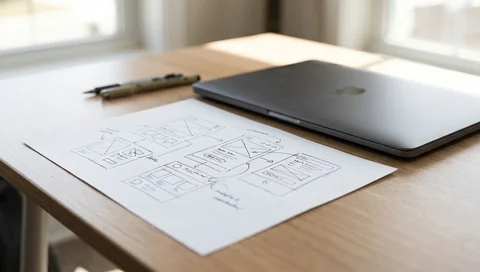
- For anything visual, a rough sketch on paper or a wireframe, and it’s usually pretty ugly on purpose.
Then I let the tools in.
That one sentence is the blank page, shrunk down to its useful part. The struggle is gone, and the decisions stay mine.
Some Parts Are Worth Keeping
I don't miss the hours of circling an empty file. I truly don’t. I also don't miss reorganizing folders to avoid writing a catchier chorus, or avoid writing a better headline.
What I'd miss, if I let it go, is the moment of deciding what I wanted before anyone or anything suggested an answer. That moment was always where my taste came from, and it's the part every draft is very good at skipping.
So I keep it. One sentence, before the tools. It's the smallest blank page I've ever worked with, and the only one I'm planning to keep.